MIXING METHOD/OLOGYData-Driven Speculation
Data-Driven Speculation
Data-driven refers to an approach or decision-making process that relies on data and evidence to inform and guide decisions, strategies, and actions. In a data-driven approach, data is collected, analyzed, and interpreted to gain insights and make informed choices. As a phrase it has been in heavy use since the early 2000s.
Speculation generally relates to conjecture, contemplating possibilities, exploring hypothetical scenarios, engaging in activities playing with uncertainty, even dreaming. Speculation, considered through an art or design lens, involves using imagination and provocation to create concepts and scenarios that inspire new ways of thinking and feeling about futures.
In general, practice-based research can be described as a generative process – moving between questions, ideas, and forms. It will engage in creative practices. Sometimes it is referred to as practice-led research. All practice-based research seeks to do things, to make things. This kind of research acknowledges that practitioners equipped with art and design skills, a creative mindset, and the will to engage in rigorous, self-directed (or collaborative) processes, are able to produce discoveries, insights, and new knowledge.
In combination, data-driven and speculation, or data-driven speculation, is a method that integrates data and imagination (and futures as needed).
Mixing Methods
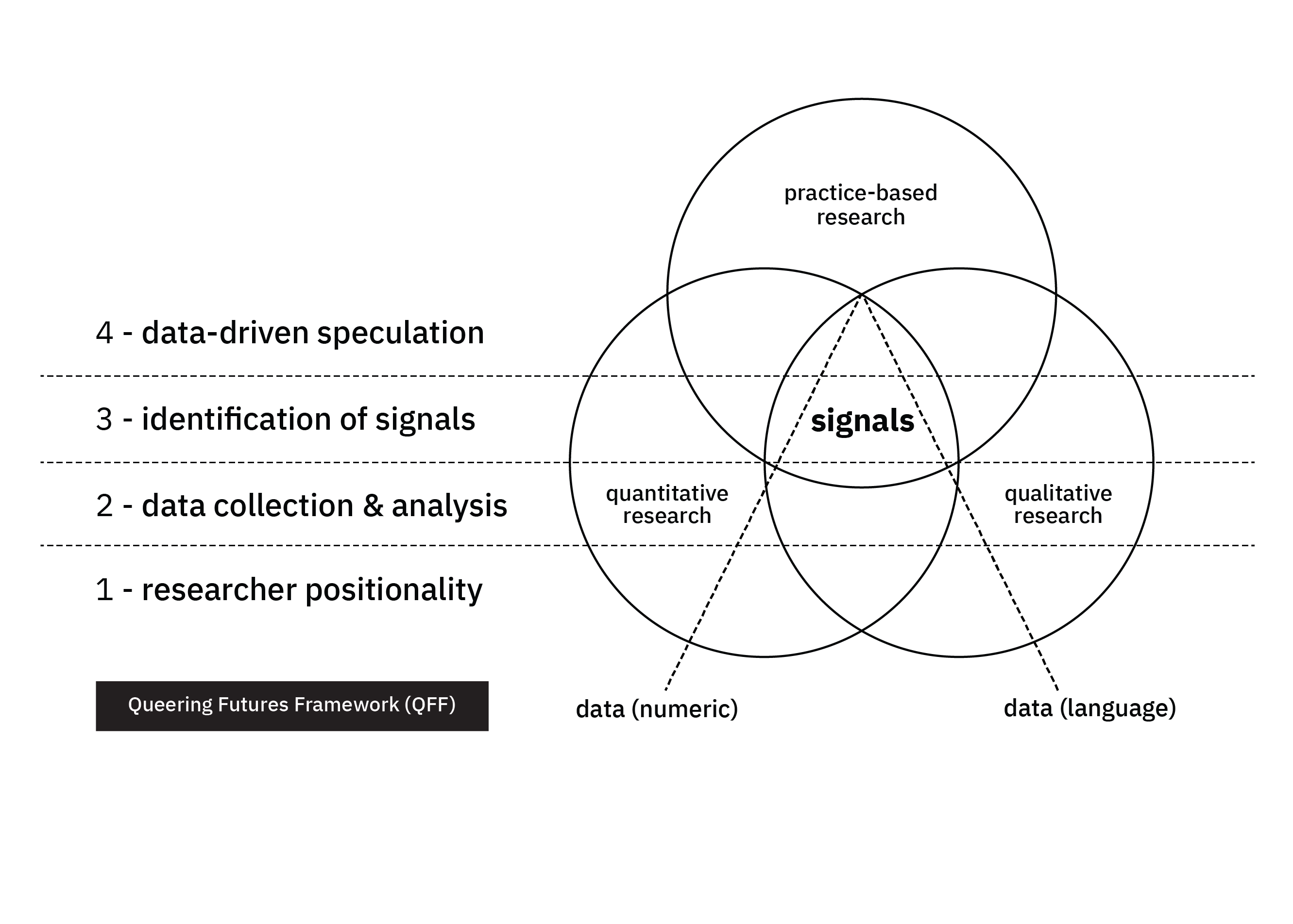
Data-Driven Speculation was born in the Queering Futures Framework (QFF). The QFF is a transdisciplinary research framework that expands mixed methods conventions, amplifies (creative) practice as a legitimate form of research, pushes boundaries, and lifts barriers. After intersecting quantitative and qualitative modes, the Queering Futures Framework (QFF) connects with a practice-based mode. It is in the culminating practice-based mode that signals observed, identified, and interpreted in the quantitative results and qualitative findings are integrated and used to inform data-driven speculation.
As with all mixed methods research designs, the Queering Futures Framework (QFF) research design overcomes the limitations of a singular approach and singular mindset and combines the strengths of multiple approaches and diverse mindsets. It is true that mixed methods are more involved than singular approaches, but if resources and time are available, mixed methods is a fantastic way to learn.
Signals
Signals are a key aspect of the QFF, and Data-Driven Speculation. Signals are dynamic signs or messages observed within data. They encompass various forms of discoverable information, such as patterns, concepts, cues, provocations, or sensations. Signals serve the purpose of conveying meaning, communicating points of interest, indicating actionable needs, or sparking imagination.
Each signal possesses its own aesthetic quality, which can range from subtle to bold, weak to strong. In the process of observing, identifying, and interpreting signals, a researcher remains open-minded, embraces ambiguity, and exercises creative license.
Ultimately, signals serve as a bridge to practice or application. It's crucial that a signal is not only relevant but also usable within the context of the research agenda.